Tuesday, April 14, 2015

Celebrity's of the Week: Spongebob Edition


Spongebob Squarepants


Patrick Star


Squidward Tentacles


Gravity CEO cuts his own pay

CEO Dan Price decided to cut his own pay by 90% in order to close the "gap" between himself and the employees. Once receiving a $1 million pay he decided that all the employees of his company should receive a raise and achieve $70,000 annually, including himself. In order to accomplish this Dan had to cut his own pay and delve into the company's profits, all to change the downward spiral of this company. Many employees were struggling to get by since some of them were making only $36,000 per year. In order to improve this stale atmosphere that was developing within Gravity Dan decided to give every one raises, and take the necessary measures to make sure every one got one. This greatly improved peoples attitudes and Dan said he used this raise as "moral imperative." The company now is receiving great responses on service and the employees could not be happier.
However Dan did mention that he would take an increase in his own wage as the company's increase to a point where it would not be harmful to the company. This is uncommon since CEO's normally deduct others wages or fire people in order to either motivate them and increase profits again. Dan proved that by deducting your own pay for a period of time and increasing others a company will not only turn around but it will flourish. Instead of motivating people through fear it's smarter to motivate employees through money since everyone likes money. The larger amount of money they are receiving allows the employees to feel economically secure in their environment, since when an employee has a problem the company will become greatly affected. "Happy employee Happy Customer"

Monday, March 30, 2015

The Recession and You

Recession - a period of temporary economic decline during which trade and industrial activity are reduced, generally identified by a fall in GDP in two successive quarters. Recessions are actual typical in economics, since economies fluctuate. These are "like a Cheshire cat, might disappear, reappear, and change shape." (5) They constantly are different and can be very hard to predict. The word alone is hard to define, so trying to predict when there will be one is just as hard. It is a period of time when all economic activity is much less then it should be, but that can happen whenever a major crisis occurs in a country. Recessions rarely lead to Depressions since "they occur when the economy's normal or recuperative mechanism fails to engage." (5) During depressions no economic activity is made which leads to many problems. Things such as unemployment rate increasing, value of things increase uncontrollably, and among other things. They are typical caused by a series of bad investments and giving businesses and consumers unneeded things that basically put down the idea of future spending.
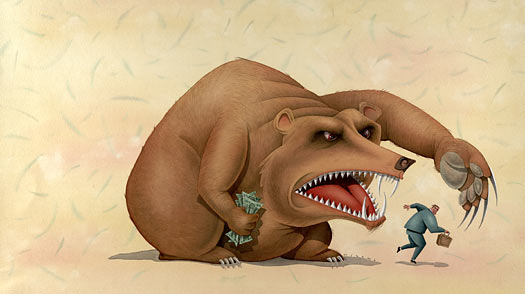
The market though does have a cycle that it follows and it shifts between two different forms of market, a bull market or a bear market. A bull market is when market activity and investments are increasing. Even in a period of time when people expect prices to raise would mean that it is a bull market. Where as a bear market is simply the opposite of the bull market. During this period of time activity is down and stocks within the stock markets drop. This however only lasts for a couple months typically. There are great examples of the different switches of market throughout the US history. Before the Great Depression the stock market experienced a bear market which meant that the investments and stocks lost all value and people began to loose money. Another example would be understanding how the stock market works. People like to buy stocks during the bear market since prices of stocks are cheap, while the bull market means that people want to sell since the stocks are worth much more than what it was before.

Tuesday, March 17, 2015

The Underground Economy

This "hidden" economy is detrimental to the function of the current economy. This economy is nothing more than the lower class or unemployed people taking upon odds and ends jobs. These jobs not only help the people earn money but it also helps/deters the current economy.
Some of the benefits are that the people are actually earning some money for them selves. Who doesn't like money, these people who do jobs like house cleaning receive their money untaxed so they will be able to spend it more freely on things they would too. The people who lost work hours in their jobs can be somewhat supported with these type of jobs as support.
There are many negatives though to this "economy". One of them are that since the money is tax free the government is losing income so they raise taxes to make up for what they are losing. This effects everyone else and creates more people to take up odds and ends jobs. This hidden economy typically is involved with elevated crime rates and drug use which is always a bad thing no matter what.

Friday, February 20, 2015

Celebrity's of the Week


Steve Buscemi


LeBron James


Dean Winchester

Rewards Vs Earnings

The US government has been using a standard system for employing people for government jobs. This system was otherwise known as the Spoils system. Before 1881, it was natural for presidents to replace federal employees with people that helped out the president during his campaign. The president is allowed to hire individuals into high ranking jobs, but before 1881 it did not matter whether or not said individual was qualified or not. The president simply held the power to do so, which is why this system is named the Spoils system because "to the victor goes the spoils." In the past the president elected people like friends or family members to high ranking positions, since they were the victor. During Washington's presidency he nominated many federalist to government positions and later when Jefferson took the reigns he cleared all the people from their positions and reelected people with views similar to his since he felt that he held not only the power but this helped deter corruption. Eventually in 1881 James A. Garfield created the Pendleton Civil Service Reform Act which basically eliminated the previous Spoils system and replaced it with a merit system. This meant that people that actually both qualify and earned the position received it. This however did not completely abolish the spoils system it simply made it harder for the positions to be given away, it seemed to be more of a way to deter presidents to give these positions away. Most of the current government positions are all determined based upon the merit system or competition based tests, despite that about 3% of the government jobs are determined by the president outside of the merit system itself.


Sources:
http://www.shmoop.com/federal-bureaucracy/spoils-system.html

Tuesday, January 27, 2015